128. Slow Food Hudson Valley
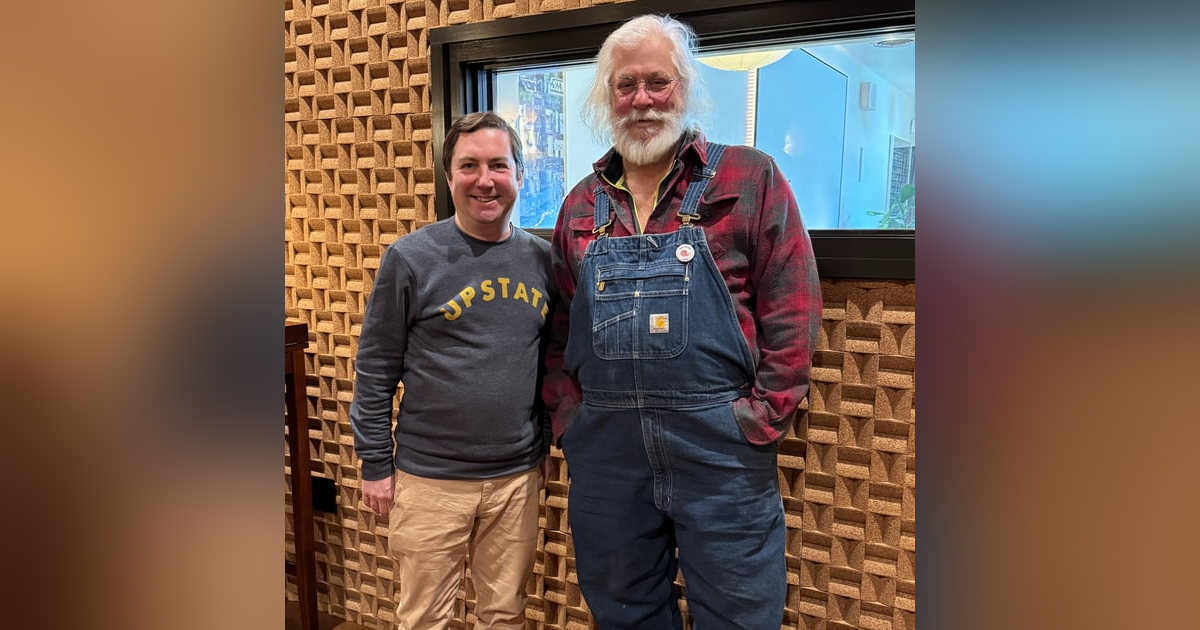


This episode is hilarious—and delicious.
Host Mat Zucker dives into the magical world of local farming and the global Slow Food movement with Pierre Fredrichs, co-chair of Slow Food Hudson Valley and owner of Overlook Farms in Kinderhook.
Recorded at the Creative Legion in Hudson, we discuss:
- The Movement: How a McDonald’s in Rome sparked a global mission for "good, clean, fair food for all."
- Life on the Farm: Pierre’s journey from private chef to tending 120 acres of pigs (including a 500-lb celebrity named Bacon!), "living sculpture" alpacas, and guinea fowl.
- Eat Local: The secrets of "egg-speriment" at his farmstand, the protein power of guinea fowl eggs, and the joy of community cookbook clubs.
- Farmer Life: Transitions from New Orleans to Montauk to the Valley, and the truth about a farmer's social life.
Special thanks to listener Jacqui Rose for the introduction and Creative Legion for hosting.
Learn more: Slow Food Hudson Valley | Overlook Farms
Other links:
- Creative Legion (Hudson)
- Talbott & Arding (Hudson)
- Kinderhook Farmer’s Market
- Chatham Farmer’s Market
- Via Carota (NYC)
- Quinnie’s (Ghent)
- OK Pantry (Kinderhook)
- Northwind Farms (Tivoli)
- Sawkill Farm (Red Hook)
- Bee Hollow Farm (Kinderhook)
- Liberty Farms (Ghent)
- Columbia Land Conservancy
Nonprofits they fundraise for:
- Columbia Kitchen (Hudson)
- Long Table Harvest
- Dutchess Outreach (Poughkeepsie)
Visit Cidiot.com for more information and links.
©2026 Mat Zucker Communications. Cidiot® is a registered trademark.
Cidiot 128 Slow Food HV Full Transcript
Pierre: [00:00:00] As a farmer, it's really hard and it's a lot of work and there's not a lot of wiggle room to make money. Buying eggs from me is gonna be more expensive than the factory farm eggs that you buy in the grocery store, but the difference is the eggs you get from me are no longer older than five days old, and the eggs in the supermarket a month old.
Mat: I am Mat Zucker, and this is Cidiot: Learning to Live and Love Life in the Hudson Valley. Today we're gonna talk about two of my favorite and magical topics, farms and food. My guest is Pierre Fredericks, co-chair of Slow Food Hudson Valley, and owner of Overlook Farms, 120 acre farm of alpacas, chickens, Guinea fowl, ducks, and pigs.
I don't know if you've heard of the Global Slow Food Movement. We'll talk about it [00:01:00] and how it got started. Provoked by a McDonald's threatening to open in Rome near the Spanish steps, the Hudson Valley Slow Food chapter is amazing, which makes sense considering the food basket. We're lucky enough to live in slow food, as you'll hear from Pierre is all about good, clean, fair food for all.
Can't believe I didn't know anything about slow food until this year, so thank you. Longtime listener Jackie Rose, who invited Brian and me to a cookbook club event in September, we celebrated Chef Casey Last's new cookbook. What can I bring By all? Bringing a dish made from his cookbook. We ate as a group at a big, long farmhouse table.
At the new Creative Legion in Hudson Creative Legion, if you haven't heard of it, is a multi-use space for creatives, makers, artists, and entrepreneurs. And it's the very place where Pierre and I came back to to record this conversation. Months later, we talk about his journey from New Orleans to Montauk and then to the Hudson Valley.[00:02:00]
From private chef to farmer. We talk about his favorite foods like dude, chicken, gizzards, dumbos, and two phases. We talk a lot about animals, chickens, pigs including a 500 pound pig named bacon and beautiful goofy alpacas, which Pierre calls living sculptures. Plus, I ask him about animal personalities and a deep dive into eggs, Guinea fal eggs.
I learned. Have more protein than regular chicken eggs and wait till you hear about experiment, which will make you drive to his Kinder hook farm stand. More about slow food, the cooking clubs, the farm walks, and the types of events you'll want to go to. I also ask if farmers have social lives. The answer is yes.
Thanks, creative Legion for hosting great events like Slow Food and letting me try out your Swank podcast studio for this conversation with Pierre. We used my remote mics, which I'm still learning to use. And kind of a city it with, but I'll get better, Pierre, at least. [00:03:00] Sounds perfect.
Music: Down in the valley, the city, it's a new way of trying get used. Idiot call first, but
I'm looking a place, but I'm trying to keep fitting to be a local, so for now I'm a city at.
Mat: Hi, Pierre. Hi
Pierre: Mat.
Mat: Thanks for coming on Cidiot
Pierre: Oh, I'm happy to be here.
Mat: I'm so glad too. And we're recording actually for everyone at Creative Legion, this amazing space in Hudson for creatives and makers and entrepreneurs. [00:04:00]
Pierre: It's a beautiful space and we're very fortunate that they have partnered with us, us meeting slow food.
They've been very generous to us and allowing us to use the space for different events.
Mat: Yeah. I think I met you at this event,
Pierre: right? Yes. At one of our cookbook clubs here.
Mat: Oh my God, I love that event. It was so amazing. It was an author. And we all had to cook a dish out of his cookbook Correct. And bring it.
It was like a potluck dinner,
Pierre: a potluck dinner out of one cookbook. So everybody signs up for what they want to cook out of the cookbook, and we share it all together and we get the author to come and be a part of it all.
Mat: How often do you do events like that?
Pierre: We do that quarterly.
Mat: Oh, nice.
Pierre: We actually just did one with Mona Talbot from Talbot Garden.
She has a. Book that she wrote with the American School in Rome when she was there with Alice Waters.
Mat: Wow.
Pierre: And it's called [00:05:00] zpa. And so it was a little different, this cookbook club, because everybody brought an ingredient that they signed up for.
Mat: Oh.
Pierre: And we cooked together two different soups.
Mat: Nice.
Pierre: And we shared it.
And we cooked like. 20 gallons of soup and what was left over. We packaged up in quart containers and sent to the free fridges in Hudson.
Mat: Oh, that's a great idea.
Pierre: Yeah.
Mat: Oh, what a great experience. I'm coming to the next one too. That's great. Maybe a place to start also would be with your relationship to Hudson Valley.
I don't know if you're from here or.
Pierre: No, I'm not from here. I'm originally from New Orleans.
Mat: Nice.
Pierre: And I grew up on a farm just right outside of New Orleans. It's been a family farm that was in our family for several generations, and I ran from it as fast as I could and moved to New York.
Mat: New York City or did you move here?
Pierre: Originally I moved to Montauk Long Island. My [00:06:00] first three years. I spent six months in Montauk and six months in New Orleans, and then I moved to the city, always had a home in Montauk and did the weekend thing up there. And then I, um, moved to the city then East Hampton. And back and forth there, and it was, you know, a great life.
But my husband and I, I guess in 2018 moved to upstate New York and I wanted a farm that I ran from as a kid. And so we bought 120 acre farm here in East Chatham, New York. And growing up on my farm as a kid, we all had to have something that we were. Responsible for, so mine was chickens. My brothers was cattle.
My younger sister was bees and pigs. So I built my first chicken coop. I guess I was about nine, 10 years ago. I had 200 [00:07:00] chickens and I sold the eggs to people in town. And even in East Hampton, I had 200 chickens and a hundred Guinea fowl on our property there.
Mat: What's the difference between a Guinea fal and a chicken?
Pierre: A Guinea fowl is from Africa. They're a dark meat bird. They're mostly black with white speckles, and they're kind of like the shape of a football. They don't have any feathers on their head. It's a funny little knot on top of their head. Looks like they've been hit on the head and got a big bump and their delicious eating.
Interesting thing about a Guinea fowl is their eggs are much smaller than a chicken egg. But they have 13 grams of protein where a chicken egg has six.
Mat: Interesting. I'll tell Brian this, I'll be very interested. Higher protein, is it common to have Guinea valves up here?
Pierre: I just love Guinea valves. People normally don't like them because they're very noisy and they actually [00:08:00] quite comical 'cause they'll run across the yard and be squawking and.
Then they'll just stop like, what am I running from? But a leaf, a leaf could fall and it scares 'em. They're also, the nickname is a farmer's watchdog because of something that they don't recognize. They'll start squawking. They're not like chickens. They will not lay eggs and a nest. They will find something to bramble.
To go lay under. So when I have Guinea foul, I have to keep 'em in a pen good part of the day so that I can collect the eggs and then I let them out. Because one thing Guinea fouls are known for are eating ticks. Yeah, they're voracious tick eaters,
Mat: so that's good. Right?
Pierre: That's great. Yeah. Right. 'cause it keeps the tick population down.
So at the farm we raise meat, birds, chickens for meat. For eggs. We have Guinea fowl, ducks that we use for eggs [00:09:00] and pigs. And alpacas and dogs and cats,
Mat: alpacas. Like what do you do with them?
Pierre: We inherited the alpacas.
Mat: They're goofy. I mean, they're fun.
Pierre: Yeah, they're beautiful. I consider them living sculptures out in the pasture.
They're
Mat: out.
Pierre: We inherited 'em when we bought the farm. The unfortunate thing about 'em, the older they get, they're fleece deteriorates.
Mat: Yeah.
Pierre: So their F fleece is not really good to sell or anything.
Mat: So who's the biggest personality?
Pierre: Who's the biggest personality? I would have to say I have a pig by the name of Bacon.
Mat: Oh,
Pierre: yes. Bacon. She's the biggest personality. She's my baby. She's about 500 pounds. And when I got our first pigs, I drove home with him and my husband comes running out. The house, whereas Bacon, pork chop and Ham Ho. So they each got assigned those names. Unfortunately, ham Ho and Pork Chop are [00:10:00] no longer with us.
Um, they were delicious.
Mat: How, how long? Oh, I was about to ask how long Pigs live. Maybe that's up to you.
Pierre: You know, I don't know the answer naturally. How long they live. Bacon's about ready to retire from. She's gonna have her last letter now and that she's gonna retire, but she's not. She's my girl.
Mat: Yeah.
Pierre: She's not going away.
Mat: And you said you just had some grand pigs?
Pierre: Yes, I had. I saw some pictures, some piglets recently, and those all are gonna be going off to harvest in the spring.
Mat: Oh, okay.
Pierre: Yeah.
Mat: Do pigs grow up that fast?
Pierre: You wanna send them six to eight months? 250 pounds is ideal to send them off. These are gonna go a little sooner because they're gonna be for a pig roast.
So you want a smaller pig.
Mat: What about intelligence? People often talk about like pigs being smart
Pierre: thing. Oh, they're smart. They're very smart. They,
Mat: how do they show it? What do they, is it memory? Is [00:11:00] it, uh,
Pierre: it's like, you know, I have a Manga, Lisa Pig, uh, her name is Buttercup. And I call her and she'll come. So they, um, they're a little ornery, but they do realize, you know what you're saying.
And, and they recognize, you know, they know the rhythm of things.
Mat: And what about the land here in the Hudson Valley? Maybe you could compare it to. To New Orleans or to even to Montauk. I just would think it's very different. It's supposedly very coveted, but it's how do you see it as a farmer? What was the experience like for you?
Switching land
Pierre: where we are is different because we're very high up.
Mat: Oh right. Overlooked farms.
Pierre: Yeah. It's very Shay and there's a lot of rocks and stuff down closer to the river. You have more stuff from. Over the years from the railroad,
Mat: how did you decide to build a farm up in the sky?
Pierre: Up in the sky?
Well, I'm not looking to grow vegetables, so I raise animals [00:12:00] and it's fine for pastures. I do have a small garden for us, but not to go to farmer's market and sell produce. I mean, down in New Orleans. Come on. You got the Mississippi River with the soil and all
Mat: right,
Pierre: right from down there. So it's.
Mat: And how does the business work?
Do you have like a farm store or do you distribute other places?
Pierre: I do farmer's markets and I do have regular clients that I do. Deliver to
Mat: which farmer's markets do you do?
Pierre: I do the Kinder Hook Farmer's Market and the Chatham Farmer's Market.
Mat: Nice.
Pierre: And also I do a big wholesale business.
Mat: Oh.
Pierre: Via Corona and New York City.
They get about 500 dozen eggs from me a week.
Mat: Wow. That's a good contract.
Pierre: Yes it is.
Mat: That's
Pierre: a, they're of them.
Mat: Those
Pierre: are on Talbot Ting. Yeah. Buy a lot of eggs. Quinnie. Okay. Pantry. So I, I do a lot of wholesale, regular hill market in the [00:13:00] city buys eggs from me.
Mat: Yeah. Oh, very nice. I also wanted to ask you about the slow food movement in Slow Food, Hudson Valley, because I've been looking it up and I heard the story about like, I dunno, started with the McDonald's by the Spanish steps or something, and then.
But it makes sense why it's big here, but how did you get involved in that? Or tell the listeners about what Slow Food Hudson Valley is
Pierre: like you said, it did start in Italy in the eighties by a gentleman by the name of Carlo Petrini, and it was McDonald's being built across from the Spanish steps, and so there was a big protest about we don't want.
Fast food, right? We want slow food. I originally got involved with slow food. My first event was a friend took me to a slow food dinner in the North Fork of Long Island, and I learned more about what they were about. So I got involved with the local chapter on the east end of Long Island, and it was just getting started.
And I became a [00:14:00] volunteer with them and eventually became a board member. I was the treasurer, then vice chair, and then chair. And one thing we did out there, we worked with school gardens. That was our big thing. When I left. We were supporting 32 school gardens on the north and South Fork of Long Island's.
A lot. It is. And some of 'em, we helped get greenhouses. Some of 'em were just getting started with raised beds. Some of 'em had outdoor classrooms in their gardens, and it was used by multiple curriculums. We partnered with like-minded organizations to help build the chapter, and we raised quite a bit of money that we were able to support these gardens through.
Being on the board of Slow Food East and I, once a year, we would have a statewide gathering of the slow food chapters throughout the state, and I [00:15:00] met the people from Slow Food Hudson Valley and we became friendly. And then when I moved up here, I became. At the time they called us governors, but now we're councils for Slow Food USA.
So I'm council for Slow Food USA for Upstate New York.
Mat: Nice.
Pierre: In that role, we helped chapters get started. We helped chapters grow. So when I moved up here, the pandemic came, collapsed. Everything, the slow Food Hudson Valley chapter was just falling apart. I worked with them and I took it over. And it was more down Poughkeepsie way.
A lot of the people who started it were from the CIA and it was somewhat involved
Mat: for listeners. That's the Culinary Institute, not the other one.
Pierre: Yes,
Mat: actually,
Pierre: yes. Yes. In Hyde Park.
Mat: I mean, I found out about it through Jackie Rose, who's the Cidiot, who's I think on your board, and she invited me and Brian recently to [00:16:00] that event here, actually here at Critical Legion.
Then we came up to another one, the Ellis Waters event, which was phenomenal. Yeah, so I was really grateful that she got us. Involved, but that's a big region. So is it one giant chapter for the Hudson Valley?
Pierre: It really should be multiple chapters, right? 'cause you got the river that divides us. So it should be, yeah, a chapter on the west.
Yeah, and the east side of the river. So it is from Metro North. So that kind of takes up Putnam County and Westchester and then Dutchess. Columbia County. So we are that area and we do something events over across Kingston Way.
Mat: Yeah. So is it basically quarterly events, like the cookbook thing and then things in between?
Or how does it work?
Pierre: We do events about monthly. Oh. And they're all on just the cookbook clubs. The cookbook clubs. We just do quarterly.
Mat: Yeah.
Pierre: But
Mat: first a link to it. Am I in the show notes?
Pierre: We do educational things. [00:17:00] At Montgomery Place was Susan Chip. We did a cheese making class. Yeah. We do farm walks. Last winter we did a farm walk at Kinder Hook Farms where we got to walk out in the pastures and talk to the farmers and see how, what happens in the wintertime.
I mean, it was like a snowy, cold day and we all bundled up and it was actually, it was funny 'cause we walked up this big hill and they had sleds up the top that we all got to slide down the hill. So it was a lot of fun. But we got to see what happens in the wintertime and how they manage the animals. In the winter,
Mat: is it a lot of farmers?
Farmers like you, or is it a lot of farm fetishizes? Like me,
Pierre: it's people who just wanna learn more about where their food comes, how it's raised. It's not necessarily farmers, but it's people who want to know more about farming. And a good part of slow food is about good, clean, fair [00:18:00] food for all. So it's.
Good for us to eat. It tastes good. It's local clean. It's clean for the environment, it's clean for us and fair. It's a fair wage for the workers. It's a fair wage for the farmers. It's a fair price for the consumers.
Mat: How would I know if something's fair or not? Should I just assume if I go to a farm store?
It's public fair.
Pierre: I think it's fair because honestly, as a farmer now. I've been in the restaurant business my whole life. In 2018, we bought the farm, but now as a farmer, it's really hard. It's a lot of work and there's not a lot of wiggle room to make money. So buying eggs for me is gonna be more expensive than the factory farm eggs that you buy in the grocery store.
But the difference is the eggs you get from me are no longer older than five days old. And the eggs in the [00:19:00] supermarket a month old. And there's ways that you can test to see how old an egg is. If you hard boil an egg and you crack it open and you get a flat end. That's because eggs are porous and the white evaporates.
Mat: No, it did not.
Pierre: Yes, that's in their pocket. So if you take an egg and put it in a bowl of water, it should lay horizontal. If it starts tilting up, it is getting older. So the more it tilts up, and then eventually it will float up to the top of the water.
Mat: Wow.
Pierre: Vertically. So that's how you test to see how old an egg is.
Mat: Oh, that's cool.
Pierre: Eggs do last a while.
Mat: Question. Fridge or no? Fridge?
Pierre: I was getting ready to go right there, but Okay. Eggs when they're laid, and if you see an egg when it's just laid, there's a wet coating on it. So they put [00:20:00] a coating on the eggs that kind of seal 'em up. We have to wash our eggs to sell them.
Then they have to be refrigerated. But as long as I don't. Wash that coating off, I can just put 'em on the counter.
Mat: So when I buy them, then should I put them in the fridge or should I need
Pierre: Yes. Unless you know they haven't been washed.
Mat: Oh, got it. Okay. I didn't get that. Are there other like mistakes that you see like citys or newcomers make when it comes to buying local or buying from farms?
Pierre: The biggest thing is get to know your farmer. Some of my. Friends I've developed are customers, and it's just how we have a relationship and I see them weekly, we talk, and it's important to know where your food comes from and how it's raised.
Mat: Yeah, yeah. I mean, I got to know North Wind Farms, they were on the show, and Cali from Salt Kill Farm in Red Hook.
She taught me a lot about her eggs and they were delicious. 'cause the bugs, they ate the bugs and that was her secret.[00:21:00]
Hey, Citi, it's, it's Matt. Thanks for listening to season nine. I hope you're enjoying it. I'm looking for a couple things. One is a sponsor or two for this new season, so definitely let me know if you can recommend anyone or if you're interested. I also just launched my new substack called Sugar and Spice.
Which talks a lot about being a cate, but also marketing and memoir and other things that start with M. So look for it@mattzucker.substack.com. Okay. Be sure to sign up for the city newsletter as well, the citi.com, and
Music: let me know what you think. You should hear more of this season and most of all come visit.
Mat: When's the best time to make plans with a farmer? You guys are working so much. So if we needed to have a dinner party. Would it be like a Tuesday night in the winter or would it be, how do you be friends with a farmer?
Pierre: How do you be friends with the
Mat: or do I just visit you every week at the farm stand?
Pierre: We do have social lives and the nice thing about winter. Especially [00:22:00] having, we have 3,500 chickens, so you 2 35, 500 chickens, everybody gets to go outside and be chickens. So it's like you get to eat your bugs, you get to go out and scratch in the ground. You get to go out and have dust baths, and then at night you get locked up because we've gotta keep you away from the coyotes and the V and the possums and raccoons and we, and whatever.
The good thing about wintertime is the sunsets at. Four 30 and the chickens go to bed at four 30 and the summertime, 9 30, 10 o'clock.
Mat: Yeah.
Pierre: So that's the hard thing with chickens is getting them to go in and go to bed. So
Mat: you've gotta be on duty until,
Pierre: yeah, we sunset, we do at Overlook Farms, we have livestock guardian dogs that live with the chickens, and so those houses were a little more.
Lenient with locking them up. So if we [00:23:00] do go out to dinner. We know they, they're somewhat protected 'cause the dogs are there protecting them. So we, we do have Social Lives
Mat: and with Slow Food Hudson Valley, what's the best way for someone to get involved
Pierre: in? You can volunteer, you can come to the events.
You can check us out on Instagram, slow Food Hudson Valley or on our website Slow food hudson valley.org. And we always have exciting events. We actually in. February, we're having beekeeping 1 0 1, introduction to Beekeeping, and that's gonna take place at the Kinder Hook Library with Master Beekeeper, Paul mcfe.
He's from Bee Hollow Farms and Kinder Hook. He's just going to do a talk in presentation on keeping bees. April 26th, we're having our big fundraiser. Uh, it's gonna be at Liberty Farms. It's called Wild Hudson Valley, so it's gonna be based around. The [00:24:00] spring foraging with a pig roast.
Mat: Oh.
Pierre: So we're gonna have a couple of pigs, but
Mat: not bacon.
Pierre: Not bacon. No. Bacon's too big. These are gonna be smaller suckling pigs and the pigs are coming from overlooked farms.
Mat: What do you fundraise for? I, I noticed in one of the events you were raising money for Columbia Kitchen, which is right near me, which is a food pantry or food delivery service.
Pierre: One thing is slow food.
Hudson Valley. Is focused on, and part of our mission is food insecurity.
Mat: Yeah.
Pierre: So we have partnered with three different organizations, Columbia Kitchen, long Table Harvest, and Duchess Outreach. So we've spread ourselves out through the area region. So back in December we just gave. $10,500 to these three organizations, which was needed at the time with all that's going on.
Sure. We're looking to help [00:25:00] start some school gardens in the area. And so that's another thing we'll help support with the money that we raise.
Mat: Yeah.
Pierre: I firmly believe in school gardens because one, it teaches kids about growing food and where their food comes from, and it's another form of food insecurity that they know that they can go out and grow that some food if they need to.
And it's interesting to see kids. I've had kids come into a garden and pick. Sugar snap peas off and just bite into it and love it. And mother's going. They won't eat that at home.
Mat: It was for me too. I tried, I won this auction thing and I won a garden plot from Sam Rose in Red Hook. And so for a summer I did this experiment.
Where I tried to teach myself to garden in this community garden, which was great 'cause I, a lot of people were helping me and I, I did vegetables versus flowers who would [00:26:00] survive. Right. And actually everybody survived. I couldn't believe it, but my timing was terrible. I came to get the broccoli too late, so it was bitter.
I didn't kill everything like I thought I was, it was a great experience. It changed my life. I'm basically a child,
Pierre: you know, growing vegetables and cooking are kind of similar.
Mat: Yeah.
Pierre: You can't be afraid of it. You just have to. Go into it and you'll make mistakes. You'll survive.
Mat: In terms of cooking, maybe 'cause you're from New Orleans, so like if you were to make a dish,
Pierre: I am a chef.
Before I became a farmer, I was a chef.
Mat: So this is a good question for you then. If you were hosting a Welcome to the neighborhood dinner for a group of new transplants for, for city it. Basically, what's a dish you might serve or dinner to give 'em a true taste of this journey? This New Orleans, I guess Montauk too and up here.
Pierre: That's an interesting question.
Mat: I mean, you could just do takeout from TVO and Art too.
Pierre: That's what I, yeah. Yeah. I could, but that's not what I would do. Whenever I would go home to New Orleans, my mother would [00:27:00] ask me, what do I want her to cook for me? And my answer was always stewed chicken gizzards.
Mat: Stewed chicken gizzards.
Pierre: That is one of my favorite things to eat. Stewed chicken gizzards. They're so delicious and I cook them all the time and people make faces at it and they taste it and love it.
Mat: Yeah, don't tell them what it is.
Pierre: Well, it's obvious what it is. It's there. But that's my New Orleans thing.
Mat: Great.
Pierre: As a chef, I was a private chef in the Hamptons for many years, and it was seasonal work, usually for summer people out there that I worked for. But after cooking for four months for them and trying to come up with menus every day. And be different. My default towards the end was always going home to Louisiana.
Food Gumbos. Tufe is
Mat: tufe.
Pierre: [00:28:00] Tufe is, it's a kind of a tomato base seafood dish, and one of my favorite things that I just cooked up here for slow food does a cookie swap each December and this year I added a component of. To the cookie swap we had. Two different type of gumbos that I made. I made a chicken gumbo with on dey sausage, and then I made something called that's very Louisiana.
It's called Gumbo Zab, and it is a vegetarian dish, which is usually something we serve at Lent. When you're not supposed to eat meat, and it's made with either five or seven different types of greens, mustards, collards, kale, Swiss chard, whatever type of greens you can get. You just cook it all together.
Wow. With onions and peppers and you just stew it and then you. Puree it and you serve it over rice with fle powder, and it is [00:29:00] so delicious,
Mat: so hungry, and
Pierre: it's so delicious. My favorite version is to do it not as a vegetarian dish, but to do it with on Dewey sausage, and that's all pureed and it really does within Dewey sausage, somehow it picks up seam seafood, cubo flavor.
Mat: Nice
Pierre: and all this is served over rice. I'm a big rice eater. That's what we grew up with down in Louisiana. It's rice.
Mat: Oh, that's great. Because I'm glu to phrase the rice is helpful. So at farmer's markets, what's your advice for people to go? 'cause it's often like a thing you do on a weekend, you know?
Pierre: Well, I think the most important thing is to.
Do it on a regular basis. The difference is, you know, going to the farmer's market, I have a farm that I barter eggs for and they give me bags of greens, Mexican greens, and those greens I get will last me stay very [00:30:00] fresh for. A week and a half, two weeks, and they're just as good as they were when I brought 'em home.
'cause they were just cut. So you can buy and things last longer, but it's about building those relationships, make it part of your weekly routine to go and enjoy the community. I mean, a lot of farmers' markets have music. Food that you can buy. So make it an event.
Mat: It's a lot of time for you guys to be standing there.
It's like a huge amount of hours.
Pierre: Yeah, it is usually four hours, but the Troy Farmer's market is really a great farmer's. It's huge. There's a lot of food as you get. You have people coming in from out of town, take the day, ride up to the Troy Farmer's Market. There's a lot of great food up there.
Mat: I do the Copake Hillsdale one a lot because I can walk my dog on Rogensen the park.
Pierre: Yeah, that's another great farmer's market is the Hillsdale farmer's market. They have a lot of great vendors. You can get food prepared foods there. But also another important thing about farmer's market, bring cash farmers. It's [00:31:00] hard to. Make a living due when we have to take credit cards and pay that three point, whatever, that all adds up to us.
It's taken away from our revenue. So bring cash or a check. Most foremost a check. I will take a check.
Mat: I don't wanna be stuck behind the person writing a check.
Pierre: Well, you don't want me stuck to the person in front of me because I'm like chatting away. I have my whole egg spiel. For one thing, we were talking about the Guinea fowl and chicken eggs and duck eggs.
One of my big sellers is at the farmer's market is an egg
Mat: experiment.
Pierre: Egg experiment.
Mat: What is that?
Pierre: You get four duck eggs, four chicken eggs, and four Guinea and eggs.
Mat: Oh. It's brilliant marketing
Pierre: and you can go home and have an exciting time. They excellent. They exceptional.
Mat: I'm a drive just for that.
Pierre: My whole point in telling you about this is that I can chat forever and people are like, come on, [00:32:00] move.
'cause I've heard the spiel before.
Mat: Yeah. You're a creative farmer though.
Pierre: At my farmer's markets, I do have a display with all the different eggs that I sell and they're all cracked open from quail eggs to Wow. Goose eggs when I have goose eggs. Goose eggs don't last very long because
Mat: they're a little bigger, right?
They're
huge.
Pierre: Yeah, they're big, but they only lay about 20 eggs a year.
Mat: Oh,
Pierre: so once
Mat: they're precious.
Pierre: Yeah. So once they're gone. But I do have a hollowed out one that I have there. Just as a display.
Mat: I'm gonna get in the car and drive to experiment. Get an experiment.
Pierre: Yeah. But I just want to thank Melissa and Creative Legion.
For hosting us today and they've been great supporters of Slow Food Hudson Valley.
Mat: Yeah,
Pierre: they allow us to hold a quite a few events here. We have one coming up in May here, that's another cookbook crowd with my friend [00:33:00] Trinity Woolford. The name of the cookbook is Eating At Home and it's basically about how simple it is to create a great meal at home.
And you know, if you buy the local one thing is. You don't need to do a lot to the food. Let the food stand on its own. It's very Alice Waters. So that's happening on May 3rd here at Creative Legion and
Mat: the Alpha Links to Creative Legion as well as to S Slow Food, Hudson Valley, and to overlook Farms in the show notes.
Music: Down in the valley, moved up from the city. It's a new way of living and I'm trying to get used to one announced I'm idiot ordered Manhattan, and they call me a Cidiot first, but
when you to the country, when you, I'm looking a place, but I'm trying to keep [00:34:00] it long to be a look, so now I'm a cidiot.
Cidiot. I'm a cidiot. I'm a cidiot. I'm a cidiot. I'm cidiot, cidiot.